
When someone calls 911, they do not stop to think about how the EMS system works behind the scenes. They simply expect help to arrive quickly—and that the care they receive will be safe, skilled, and compassionate.
That expectation is not fulfilled by one person, one agency, or one organization alone. It is made possible by a connected system of professionals and partners working together with a shared commitment to public safety.
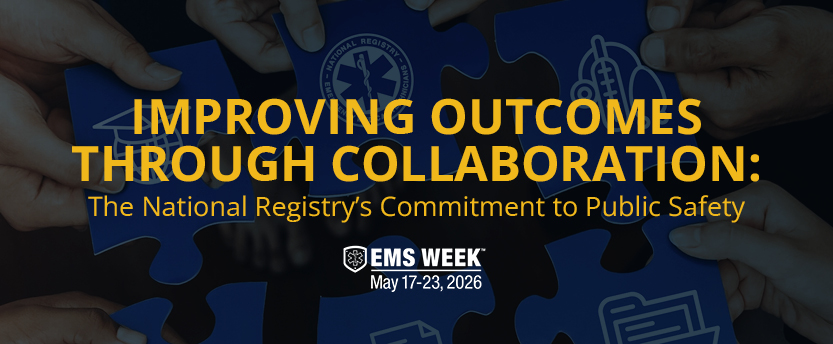
This year’s EMS Week theme, Improving Outcomes, Together, reflects a truth long understood across the profession: the best patient outcomes are achieved when education, certification, licensure, and credentialing work in alignment. Each plays a distinct role, but all are essential. And when those parts work together, the entire system is stronger.
A System Built on Shared Responsibility
The national EMS system is built on four foundational components.
- Education prepares future EMS Clinicians with the knowledge, judgment, and hands-on clinical and field experience needed to enter practice.
- Certification verifies that an individual has demonstrated a nationally recognized standard of entry-level competency.
- Licensure, granted by state or local authorities, authorizes a Clinician to practice within a jurisdiction.
- Credentialing, determined by employers or Medical Directors, defines the specific responsibilities and procedures a Clinician may perform in each setting.
Each of these functions carries a different responsibility, but none can stand alone. Public trust depends on a system in which every part is doing its job well and doing it in coordination with the others.
That is what strengthens public protection. That is what supports workforce readiness. And that is what ultimately improves patient outcomes.
The National Registry’s Role in the System
Within that broader system, the National Registry serves as the nation’s certification partner.
We do not grant licensure, establish state policy, or define local scope of practice. Those responsibilities rightly belong to state and local authorities, employers, and medical oversight. Our role is different, but no less important to the integrity of the system.
The National Registry’s core responsibility is the development and administration of high-quality professional certification examinations that help ensure Clinicians entering practice are prepared to provide safe, effective care.
These examinations are built on well-established principles of validity, reliability, fairness, and clinical accuracy. At the EMR, EMT, AEMT, and Paramedic levels, National Registry certification assessments are designed to consistently measure the essential knowledge and clinical reasoning required for real-world EMS practice.
That standardization matters.
It helps ensure that every individual who earns National Registry certification has demonstrated readiness to serve patients and communities with competence and care. It also supports a fair and equitablecertification process, one that upholds the profession and reinforces the public’s trust in it.
Collaboration that Strengthens the Profession

The National Registry’s work has always depended on partnership.
State EMS Offices, Educators, Medical Directors, subject matter experts (SMEs) employers, and Clinicians all contribute to the strength of the certification process and, by extension, to the strength of the EMS profession itself. This is not work done in isolation. It is work done in collaboration.
That collaboration also reflects something larger: a shared responsibility to advocate for a strong, prepared, and trusted EMS workforce.
When organizations work together to uphold quality, consistency, and professional standards, they are not only protecting patients in the moment; they are helping advance the profession for the future.
Developing psychometrically sound, legally defensible, clinically relevant certification examinations requires specialized expertise, rigorous methodology, and significant investment. Through peer review, stakeholder engagement, continuous research, and adherence to nationally recognized accreditation standards, the National Registry provides dependable assessments that support sound licensure decisions and public confidence.
These partnerships also help promote consistency across the EMS system, support workforce mobility, and strengthen coordinated response capabilities, especially during disasters, large-scale emergencies, and multi-jurisdictional events where readiness and interoperability matter most.
Impact Across the EMS Community

The value of certification is felt across the entire EMS ecosystem.
For Clinicians, National Registry certification provides national recognition, affirms readiness for practice, and supports professional mobility and opportunity. It reflects a commitment to competence and reinforces trust with patients, peers, and the communities they serve.
For employers, certification offers a reliable benchmark for identifying qualified personnel, reducing training variability, mitigating operational risk, and supporting a culture of ongoing competency.
For State EMS agencies, partnership with the National Registry provides access to high-quality examinations grounded in peer-reviewed standards and sound measurement practices, helping strengthen public protection through a consistent and credible certification foundation.
And for the public, this collaborative system helps ensure that when care is needed most, it is delivered by professionals who have met a recognized standard of preparedness.
Improving Outcomes, Together
A strong national EMS system does not happen by accident. It is built, and sustained, through collaboration, trust, and a shared commitment to doing what is right for patients and communities.
That means educators, certifying organizations, regulators, employers, Clinicians, and advocates all have a role to play.
During EMS Week, we are reminded that improving outcomes is not the work of any one part of the system. It is a collective responsibility and a collective opportunity.
The National Registry is proud to fulfill its role in that effort by supporting Clinicians, partnering with states and stakeholders, protecting the public, and advancing the standards of emergency medical care nationwide, across U.S. territories, and within the nation’s military.
Because when we work together, not just in service of the system, but in advocacy for the profession, outcomes improve for patients, for Clinicians, and for the communities we all serve.
About the National Registry of Emergency Medical Technicians
Guided by our mission to support the EMS profession through partnerships, research, and lifelong assessment of clinical competence, the National Registry was established in 1970 as a non-profit organization and serves as the Nation’s Emergency Medical Services certification organization. It is accredited by the National Commission for Certifying Agencies (NCCA), the accreditation body of the Institute for Credentialing Excellence. The National Registry maintains NCCA accreditation for each of the four certification programs: Emergency Medical Responder (NREMR), Emergency Medical Technician (NREMT), Advanced Emergency Medical Technician (NRAEMT), and Paramedic (NRP). Credentialing protects the public, assures consumers that Clinicians have met standards of practice, advances the EMS profession, and establishes standards of professional knowledge, skills, and practice. Additional information is available at NREMT.org, and BlueSky, TikTok, Facebook, Instagram, LinkedIn, Reddit, and YouTube.
Media Contact:
Kelly Schroeder
Manager of Integrated Content & Communications
kschroeder@nremt.org