
As the EMS Certification Organization

Our Purpose

Our Vision

Our Mission
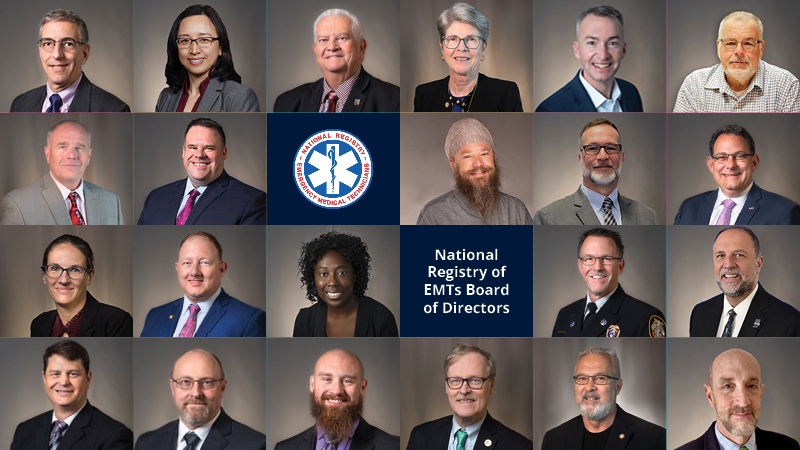
Board of Directors

Clarifying-Roles-in-EMS Oversight
The National Registry verifies competency — the knowledge, skills, and abilities needed to provide safe and effective patient care. It does NOT assess personality, character, or behavior.
Licensure and conduct oversight fall to state EMS offices, while employers make decisions about hiring or discipline. Each plays an important role in protecting the public and maintaining trust in the profession.

National EMS Data
History of the National Registry
Explore the National Registry’s historic timeline to discover key milestones and developments in EMS.
Timeline
Professional Accreditation
The National Registry maintains accreditation from the National Commission for Certifying Agencies (NCCA), the credentialing body of the Institute for Credentialing Excellence, for all four (4) certification programs:
-
Emergency Medical Responder (NREMR)
-
Emergency Medical Technician (NREMT)
-
Advanced Emergency Medical Technician (NRAEMT)
-
Paramedic (NRP)
Credentialing:
-
Protects the public
-
Assures consumers of professional standards
-
Advances the profession
- Sets standards for knowledge, skills, and practice
Examination Development
The National Registry prioritizes public safety by providing a reliable, valid, and fair method to measure candidate competency. EMS and test development experts dedicate thousands of hours each year to developing the examinations.
The National Registry certifies four (4) EMS levels—EMR, EMT, AEMT, and Paramedic. The content for each level is determined by a Practice Analysis, a research study which identifies key tasks, knowledge, skills, and abilities required for entry-level EMS care at that level. National Subject Matter Experts (SMEs), including State Officials, educators, employers, Clinicians, and physicians, are involved throughout the examination development process, including Practice Analysis, examination blueprint development, item development and review, and the determination of the standard for entry-level competency.
Learn More
Annual Reports
View our annual reports to see highlights, achievements, and financials from the last five (5) years.
Annual Reports

How States Use the National Registry
The National Registry provides National EMS Certification to protect the public. This certification process thoroughly validates and legally attests to the competency of candidates who pass.
All fifty states recognize National Registry certification as a valid attestation of entry level competency prior to issuing a license to practice. Recognized nationwide, the EMS Compact mandates this certification in all member states, assuring the public, employers, and state authorities of each individual’s proven competency.
Volunteers